
Global economic growth has already started its journey of shifting towards developing nations. Being one of the fastest-growing economies in the world, India offers plenty of opportunity to businesses looking to expand their operations in India. For a smooth business setup in India, you may need a physical presence to break into India’s developing business sector. However, only the right kind of presence can make it into the tough business scenario in India
A strong legal foundation for a new business is just as important as a sound business model. Businesses that are legally compliant from inception scale much more smoothly and realise more of their value if legally savvy from the start.
India is a rapidly growing economy and is becoming an increasingly popular destination for foreign businesses looking to expand their operations. It has a large and young population, which is driving consumption and economic growth. The country has a diverse market with a rapidly growing middle class and a strong and growing services sector, especially in the IT and digital fields. Additionally, the Indian Government has been implementing policies to encourage foreign investment and make it easier to do and set up business in India, which has made it an attractive destination for foreign businesses looking to expand their operations. These factors, along with a strategic location in the center of Asia, make India an attractive destination for businesses looking to tap into the fast-growing markets of the region. Setting up a business in India can be a complex process, but with the right information and guidance, it can be a rewarding experience
India’s manufacturing sector is on the rise, and now is the perfect time to tap into this growth. With the sector contributing 17% to India’s GDP in 2024, it’s expected to reach 25% by 2030. This growth is fuelled by initiatives like “Make in India” and “Atmanirbhar Bharat,” making it a market that promises substantial returns for businesses willing to take the leap.
But stepping into this dynamic market can feel confusing due to complex regulations, cultural differences, and the competitive domain requires more than just a great product. We’ll cover everything you need to know to turn your business vision into reality in one of the world’s fastest-growing economies. Let’s begin.
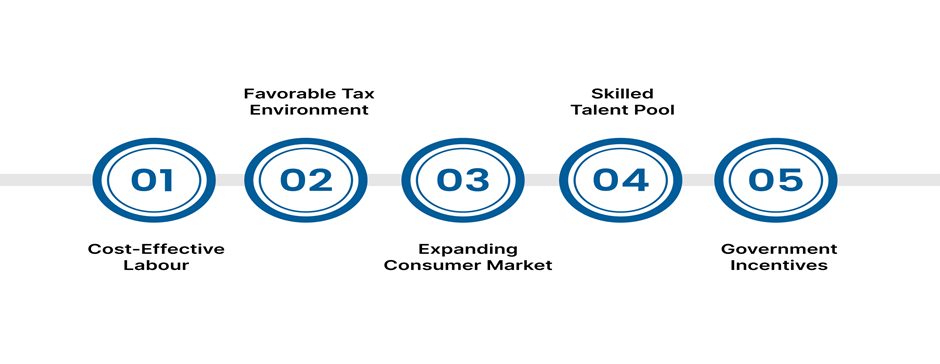
India is increasingly becoming a preferred destination for businesses, especially companies in the US, looking to expand their manufacturing operations. While China still leads the global manufacturing front, India offers several advantages that make it an attractive alternative. Here’s why:
With these advantages, India presents a unique opportunity for businesses looking to set up a manufacturing plant while tapping into a growing market and reducing costs.
Now that you know the benefits, let’s walk through the steps required to start your manufacturing business in India.
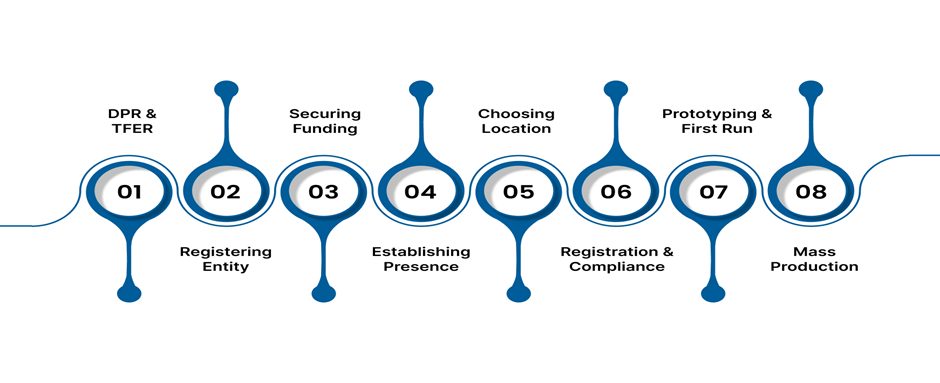
Starting a manufacturing business in India from the USA, Canada requires careful planning, understanding the legal framework, and securing the necessary resources. Here’s a step-by-step guide to help you manage the process:
We provide specialized legal assistance to Non-Resident Indians (NRIs) and foreign investors seeking to invest in or manage property in India. Our services include:
In India, manufacturing businesses can be set up as a private limited company or a public limited company. Foreign businesses can either acquire an existing company or establish a wholly-owned subsidiary under India’s Foreign Exchange Management Act (FEMA).
Alternatively, entering into a joint venture (JV) offers the benefit of local expertise and market access. The registration process is mostly online, with documents requiring notarization and apostilling. Once submitted, the registration usually takes about 4 to 6 weeks.
Adequate funding is crucial for setting up a manufacturing business. You can explore bank loans, venture capital, and government schemes like MUDRA loans for small businesses.
MSME loans are a great option, offering low-interest rates and flexible repayment terms. Platforms like Flexi Loans can provide fast access to capital without asset requirements, making financing more accessible.
Any entity, foreign or domestic, must establish a physical presence in India. This can be done by registering a partnership firm or a limited liability partnership (LLP), or a company.
Expanding into India requires understanding regulatory frameworks and setting up the right structure. We offer expert support to handle the compliance domain and establish a successful manufacturing presence in India.
Consider factors such as proximity to raw materials, transportation infrastructure, labour availability, and market access. Some Indian states offer specific incentives for certain industries, such as reduced land costs or tax breaks.
Gujarat offer industry-specific subsidies, while Special Economic Zones (SEZs) provide benefits such as tax holidays and duty-free imports. Businesses can also choose between greenfield projects (building a new facility on unused land) or brownfield projects (using existing facilities). The choice depends on the company’s risk tolerance, time, and budget.
For manufacturing plants employing more than 10 workers with power or 20 workers without power, Factory Registration under the Factories Act, 1948, is mandatory. This involves submitting a detailed building plan, environmental clearances, and safety measures.
Depending on the industry, additional registrations and licenses may be required, including environmental clearances, industry-specific approvals, and labour law compliance (e.g., Employee Provident Fund, Minimum Wages Act).
After setting up the factory, you can begin prototyping your product to test its design and functionality. Once the prototype meets expectations, proceed with the first production run to ensure that operations are smooth before mass production.
With everything in place, you can move on to mass production. Before starting large- scale production, ensure that you have secured the necessary raw materials and that your production process is optimized for efficiency.
Following these steps can help to successfully establish your manufacturing business in India, ensuring compliance and operational efficiency at every stage.
We take the complexity out of setting up your manufacturing process in India.
Setting up a manufacturing process in India presents significant opportunities, but it requires careful attention to legal, financial, and regulatory aspects. Company registration, securing necessary licenses, ensuring compliance with Indian laws, and protecting intellectual property are all critical steps for a successful business launch.
With Mehta Associate & Law Firm expertise, you can tackle these complexities and set up your operations seamlessly. Take the first step towards a smooth and compliant manufacturing setup in India: Get started today for expert guidance and support.